SPELLING FOCUS March 2026:
Please keep working on the words you have underlined in the middle of your reading records. These are the ones misspelt in the Spring end of term assessment.
Practise writing sentences using the Y5 and Y6 word lists. A sentence has to have a noun plus a verb. Add an adjective and adverb to make the sentence better. Check your spellings.
Do you know which words are nouns on the spelling list? Do you know how you can turn them into nouns?
Please keep reading the word lists at home and concentrate on the ones you are still learning to spell.
Keep using the words from the Y5 and Y6 word lists in sentences when you speak at home. Can you change the words say from identity to identify or identification and others? Make sure you know which words you and your partner have as your project words.
Words which have double letters are still our focus for now. You will need to know which have double letters in one place, two places, and three!
Can you identify about forty words from your spelling word list which contain a 3 or a 4 letter stem? Do you know which stems relate to which words? (They do not have to have similar meanings.)
There is not a spelling list right now but we are starting to develop the skill of spelling and a knowledge of word classes. To get a head-start, it would be a good idea to start to organise words into nouns, adjectives and adverbs.
Check for words within a word. Often a spelling word has four letters in a row which make another word. It could be linked to the bigger word in meaning but often is not. See if you know which word is a stem for a bigger word. Next try adding prefixes or suffixes to make the word longer. And finally, can you turn some words into antonyms (opposites) but adding two or three letters at the beginning?
Try measuring volume, mass, length, time, and money. Use estimates then check your answers. Perhaps you could get practical in the kitchen or in the workshop or garage. A useful skill to practice with measurement would be to find things in the household which show a covering in centimetres or meters squared. Can you link volume to the amount of area? Is it different depending on the contents?
Are you good at counting in fractions of different amounts? Try counting from four and two thirds up to six and one third. Record your steps and try any variation. What would be your range if you are only to count ten steps each time?
Have a go at the short division practice sheet below.
Keep working on the long multiplication. We are getting better, but not everyone has cracked it yet while some can already do long multiplication!
This page has some real life multiplication problems which are always worth the practice.
Try this link for some long multiplication practice. This one is easier and this one harder.
Do you know the difference between an improper fraction and a mixed number? What about comparing, adding or subtracting them? Make up some to test your adult on.
We've started doing fractions. Can you count in fractions? Start with a mixed number and count forwards and backwards. Next, practise saying fractions of an amount, e.g., 1/3 of 15 is five, 2/3 of 15 is 10. You can find fifths, sixths and sevenths.
If you need to, practise your times tables. The unit at the moment is multiplying and dividing so you will definitely need to know your tables inside out.
When we perform an inverse operation, we use the same numbers in a different order. Can you write two sentences to explain this? You should use the terms: the biggest number, at the end, the small numbers, at the beginning, adding, subtracting. Try doing the same for multiplication and division.
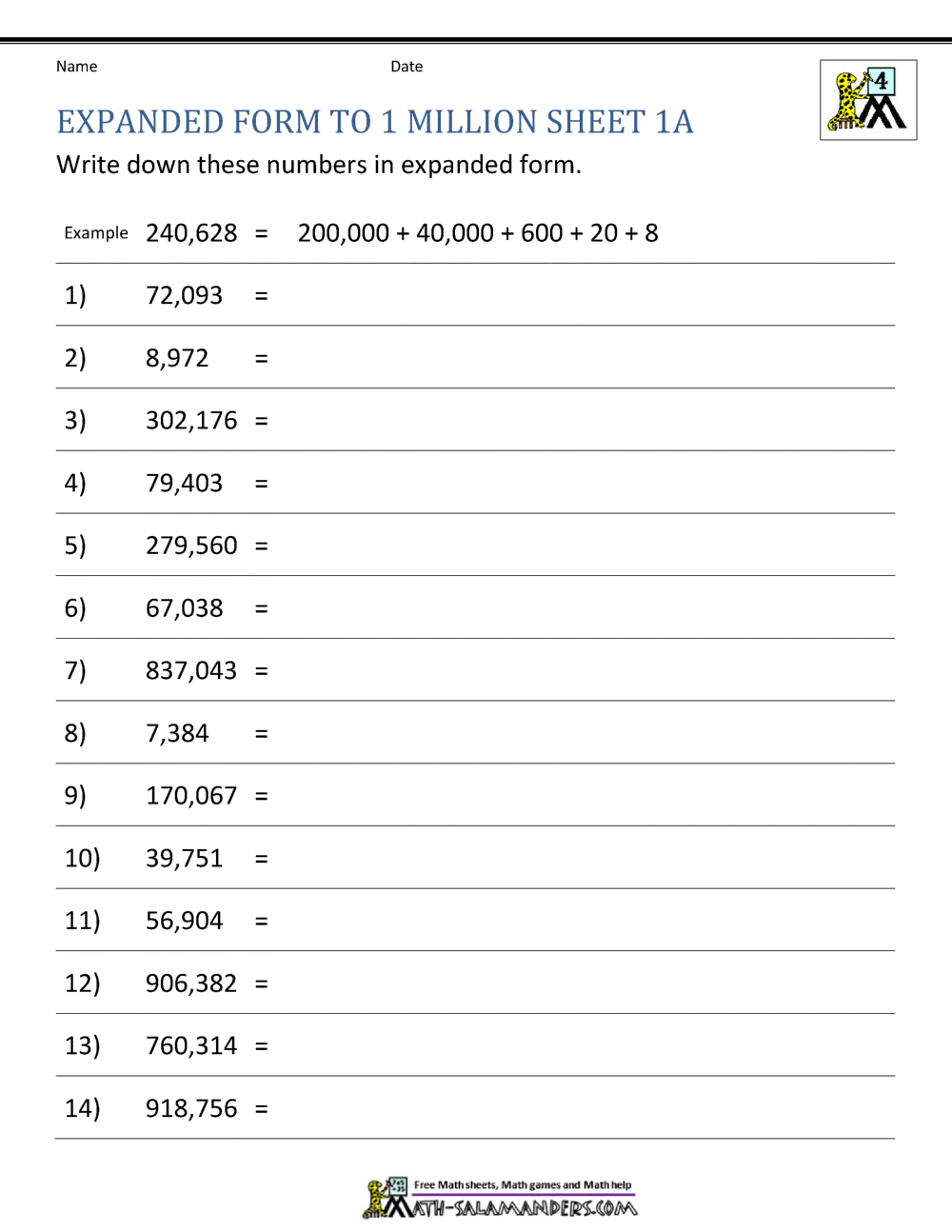
Practice saying out loud some large numbers. Write a few of them using words and numbers. If it's a four digit number less than 5000, you may be able to write using Roman Numerals.
Write a set of rules for rounding to the nearest 10, 100, 1000, 10,000 and 100,000. For example, when rounding to the nearest 100, the answer will be in the hundreds and have two zeros.